Harvard's Quest for Fulfillment
On ambition, emptiness, and the institution that thrives on both
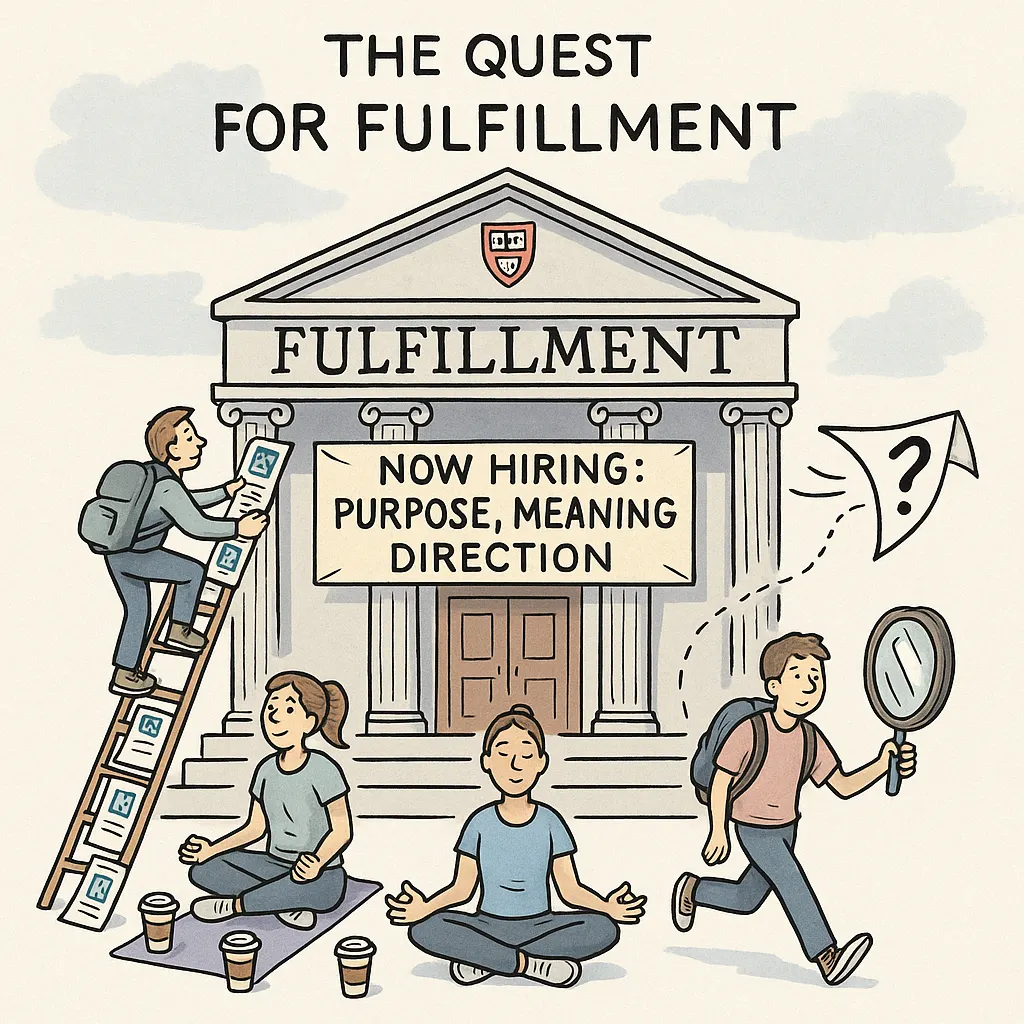
On any given day, you can find someone at Harvard walking fast but looking lost. They’re headed somewhere important—probably to a fellowship meeting or an office hours they don’t want to attend—but their face is somewhere else. Not sad, exactly. Just slightly unfulfilled.
Fulfillment is the word we whisper between deadlines. It’s what we pretend we’re chasing when we double major or join clubs we secretly hate. No one knows what it means. Everyone swears they’re looking for it.
The purpose of a Harvard education is supposedly the joy of discovery, the thrill of intellectual curiosity, and the personal satisfaction of mastering a challenging concept. However, the prevailing vision of many Harvard students is that college is simply a pathway to a universally desired outcome—a prestigious, high-salary career.
This vision is hard to escape. Harvard’s student culture perpetuates an environment where personal development is relegated to secondary consideration, a mere footnote in the grand narrative of pre-professional education and GPA maximization.
Evaluating education solely based on job prospects or social standing, an approach fostered by Harvard’s culture, misses the mark significantly. Education, in its truest form, should transcend the confines of perfect GPAs, economic benefits, and material success. It should prioritize the cultivation of critical thinking, creativity, and a lifelong love for learning, fostering well-rounded individuals who contribute meaningfully to society.
I recognize that adhering to this perspective can pose a considerable challenge, and it’s not always easy to step back from the environment of such a polarizing place. However, Harvard University and its students need to shift from a myopic emphasis on career-centric goals to a more holistic and growth-oriented approach, reclaiming the true essence of education.
The issues manifested by Harvard College students stem from practices ingrained much earlier in their academic careers. Even before students arrive on campus, there is a noticeable absence of initiatives to foster intellectual curiosity. Many ambitious high school students find themselves dedicating countless hours to meticulously crafting academic profiles, often foregoing the pursuit of subjects they genuinely enjoy.
In high school, I was encouraged by college counselors and teachers alike to pursue the debate team, the school newspaper, and various leadership roles. My roommate once admitted that his high school life had the singular objective of gaining admission to prestigious schools like Harvard. The relentless pursuit of the “next step” in education, while understandable, leads to a deleterious mindset, one where the journey of learning is overshadowed by the destination it is presumed to lead to.
Many Harvard students entered the University with a strong focus on their academic path. Upon arriving at Harvard, they find themselves in an environment that continues to prioritize grades, club involvement, and networking. While striving for academic excellence is commendable, students must recognize that there is inherent value in relishing and appreciating the rich tapestry of experiences that university life offers. Not everything has to be a means to an end.
However, it is imperative to consider the external forces that wield a profound influence on students’ experiences. Undergrads arrive with vastly different backgrounds that ultimately shape their experiences and create a dynamic weaving of identities, perspectives, and conversation. Some face the weighty responsibility of providing for their families—their journey through Harvard is intricately intertwined with the financial pressures of their households. In stark contrast, others may come from more affluent backgrounds, affording them a broader spectrum of choices and opportunities.
These circumstances influence both the pragmatic decisions students make about their academic pursuits, as well as the extent to which they can engage with the full spectrum of the college. Recognizing these divergent circumstances adds layers of complexity to the narrative of Harvard, as many students are influenced by the unique contexts they bring with them.
In my candid conversations with peers and friends, I’ve come to observe that many students, whether overtly expressing it or not, navigate their Harvard journey with a primary focus: leveraging the Harvard brand to pave the way for prosperous career trajectories or as a conduit for securing financially advantageous relationships. While Harvard outwardly emphasizes its dedication to fostering intellectual curiosity, the prevailing culture within the community often appears tilted towards a more career-centric mindset. It’s disconcerting that Harvard students are enveloped in a somewhat precarious and narrow-minded vision, fixating predominantly on outcomes.
And Harvard doesn’t just reflect this mindset—it reinforces it. The university runs on a quiet logic of engineered dissatisfaction: you should be doing more, getting more, becoming more. It’s not always said outright, but it’s embedded in the culture—in the conversations, the competition, the sense that everyone else is somehow ahead. Fulfillment isn’t framed as something you reach; it’s something you should always be chasing. The result is a student body trained to treat college like a transit map: get from point A to B as quickly and efficiently as possible—no detours, no surprises, no time to look around.
You can see it in the programming. There are Office of Career Services events that prioritize efforts like “finding purpose” through your career, General Education courses that promise “meaning” in four credits, and Commencement speeches that sprinkle in phrases like “live your truth” between calls to apply for consulting jobs. Even Harvard’s course catalog sounds like a marketing deck: purpose, impact, transformation. The effect is subtle but cumulative—like meaning is something you’re supposed to buy into, not actually build.
Harvard is not solely responsible for this mindset—I’ve caught myself falling into it too. It’s easy to default to what looks impressive on paper: the perfect GPA, the consulting club, the stacked schedule of back-to-back commitments. But lately, I’ve been trying to ask a different question: what do I actually care about? What would I choose if no one were watching?
Some of the most meaningful parts of my time here haven’t come from polished achievements—they’ve come from conversations that weren’t planned, friendships that deepened slowly, or moments when I finally let myself be curious without trying to turn it into a credential. That kind of learning doesn’t go on a résumé. But it stays with you.
In a scenario where education is viewed solely as a stepping stone to the next life phase, the concern arises: how can students allocate time to explore their true passions and develop a genuine appreciation for their education? Can one genuinely claim to have fully utilized their time at an institution like Harvard if their focus is perpetually fixed on what lies beyond college?
Even though Harvard is touted as a stepping stone to future prosperity, it’s crucial to engage earnestly with the traditional college experience. Focusing narrowly on terminal outcomes can lead us into suboptimal situations where we are enthralled with the letters in our transcript, forcing us to endure more than we ought to for the sake of long-term objectives. At the start of my Harvard career, I took only STEM classes, thinking something in that field would set me up to make the most money out of college. However, I quickly realized that creating molecular structures and solving 4D integrals was not the way I wanted to spend my time here.
I will never forget watching people cry in the Matthews Common Room because they could not find the time to complete their work. There persists a grim acceptance at Harvard that life is inherently fraught with hardships that must be endured, all for the ultimate reward of living up to conventional standards of academic success and securing a prestigious position in the workforce.
This is not to suggest that academic endeavors and professional experiences are trivial. Rather, I advocate for a recalibration of priorities, where the purpose of one’s time at Harvard is not singularly defined by wealth accumulation and focus on the next step of life.
I don’t think Harvard has to promise fulfillment. But it should at least stop branding the chase as the point. The institution excels at producing people who are brilliant at becoming things. But sometimes I wonder: when are we allowed to be something, too?
Meaning doesn’t always come from the polished milestones we’re taught to pursue. It shows up in stranger places: a conversation that cracks something open, a friend who stays with you in silence, the feeling of realizing you’ve changed and didn’t notice it happening.
If Harvard wants to be more than a prestige machine, it has to make space for those moments, not just reward what comes after. The real education isn’t in how to win. It’s in how to pay attention, especially when no one’s grading you for it.
**This adapted article was originally published by the Harvard Independent on 12.07.23**
Thoughts? Reply by email.