The Show Must Go On
Media, Ritual, and the Politics of Power
**This assignment was completed as a final project in one of my S25 classes.**
[1] Power today rarely arrives with commands. More often, it operates in form: the structuring of time, the choreography of visibility, the formatting of speech. It circulates through media not as content, but as rhythm, tone, and repetition. The more familiar these forms become, the more invisible they are. What once distracted us from the system has become the system itself.
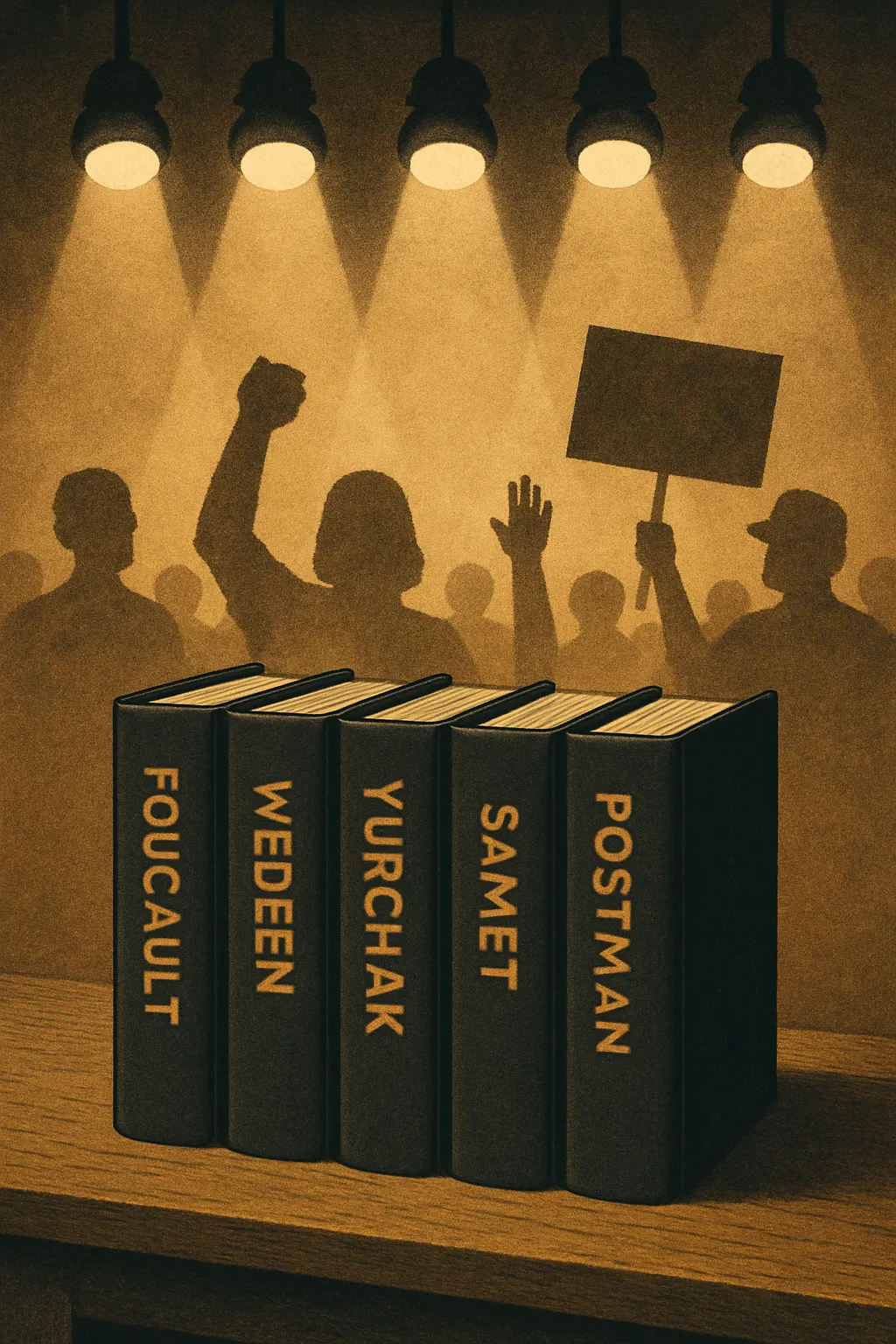
[2] In Discipline and Punish, Michel Foucault shows how modern power works by making people visible—by producing subjects who can be watched, known, and measured. Lisa Wedeen’s Ambiguities of Domination traces how power in authoritarian Syria functions not through belief, but through compulsory public performance. Alexei Yurchak’s Everything Was Forever, Until It Was No More explores how late Soviet discourse continued to function even after belief in its content had faded—sustained instead by ritualized repetition. shows how the press in Venezuela doesn’t just report crisis—it performs it, turning outrage into a stage for populist power. And in Amusing Ourselves to Death, Neil Postman argued that television doesn’t just deliver content—it reshapes how we understand truth, making politics more about performance than substance.
[3] Across prisons, parliaments, pageants, and pressrooms, these thinkers chart a shift: power no longer rules through conviction, but through the repetition of familiar forms—circulating through the media, and embedding itself in the rituals we mistake for routine. From Soviet slogans to Venezuelan headlines and American soundbites, domination doesn’t declare itself—it stages itself, repeating forms until performance stands in for belief. What matters is not persuasion, but participation. Not truth, but choreography.
[4] This paper follows the evolution of that shift through the work of five theorists. From Foucault to Wedeen, Yurchak to Samet, and finally Postman, each shows how power no longer relies on overt control but on the subtle arrangement of what can be seen, said, and circulated. Together, they reveal how modern authority is staged: in slogans repeated, realities staged, and grievances broadcast. Media, in this account, is not the mirror of power—it’s the medium through which power is made legible, affective, and real.
[5] Power doesn’t always announce itself with spectacle. As Michel Foucault argues in Discipline and Punish, one of the most enduring transformations of modern power came when states shifted away from the sovereign rituals of public punishment and toward more diffuse forms of discipline—what he calls a “specific technology of power” that targets the body (Foucault 194). Under this regime, subjects are not simply ruled from above—they are trained, observed, and normalized from within. “Discipline,” Foucault writes, “produces subjected and practiced bodies,” turning individuals into “docile bodies” whose behaviors can be predicted, recorded, and controlled (Foucault 138). Unlike spectacular punishment, disciplinary power is “a modest, suspicious power” that embeds itself into the fabric of daily life, functioning less as display than as design (Foucault 170).
[6] The key mechanism of this shift is visibility. Power, paradoxically, becomes effective through its invisibility—it need not be constantly asserted to function. Yet, it imposes on those it governs a constant compulsory visibility. “The fact of being constantly seen,” Foucault writes, “of being able always to be seen, that maintains the disciplined individual in his subjection” (Foucault 187). This is the logic of panopticism: a system in which power should be visible but unverifiable, such that the subject never knows when they are being watched and therefore internalizes the surveillance.
[7] Foucault’s critique of power is also a critique of knowledge. He dismantles the fantasy that knowledge exists apart from domination, insisting that “there is no power relation without the correlative constitution of a field of knowledge, nor any knowledge that does not presuppose and constitute at the same time power relations” (Foucault 27). Knowledge is not merely distorted by power, it is produced through it. The very techniques that discipline bodies—observation, measurement, classification—also create the categories that render subjects visible, knowable, and governable.
[8] Each person becomes a “case”—at once an object of analysis and a target of intervention. “It is also the individual who has to be trained or corrected, classified, normalized, excluded, etc” (Foucault 191). The body is rendered visible, recorded, and ranked. An archive is formed, not unlike a media system, where visibility determines what is remembered, circulated, or erased. What emerges is not a sovereign subject but a calibrated one: constructed by grids of intelligibility, situated within a “permanent corpus of knowledge,” and subjected to the quiet regularities of normalization. (Foucault 190). This is not the power to repress—it is the power to define.
[9] What Foucault gives us, then, is a way of understanding power as less an act than an arrangement: a system of techniques and signs that makes people appear, makes them legible, and makes them manageable. As later authors show, modern media doesn’t just represent reality; it shapes the field in which certain realities become visible, legible, or sayable. Before politics turns theatrical, it begins with discipline: a quiet ordering of who gets seen, and how.
[10] Wedeen extends Foucault’s insight into a world where discipline becomes spectacle. In Ambiguities of Domination, she shows that the Syrian state does not rely on belief so much as performance. “People are not required to believe the cult’s fictions, and they do not,” she writes, “but they are required to act as if they did” (Wedeen 30). Power, in this system, is not about truth—it is about pretending. The regime doesn’t persuade; it scripts. Borrowing from Foucault and Geertz, Wedeen calls this “‘disciplinary-symbolic’ power,” a structure in which domination is sustained through rituals of absurdity enacted by citizens who know better but comply anyway (Wedeen 30). These rituals resemble state-sponsored media loops—inescapable, stylized, and endlessly replayed across public life.
[11] This as if logic is central. Authoritarian control in Syria is not maintained through belief, but through performance. “The pageants,” she writes, quoting Clifford Geertz, “were not mere aesthetic embellishments… they were the thing itself” (Wedeen 14). Slogans, titles, and symbols do not describe power—they enact it. Their exaggerated absurdity isn’t accidental; it’s intentional, designed to compel public displays of compliance. “Official rhetoric and images operate as forms of power in their own right,” Wedeen explains (Wedeen 5). Citizens are forced to participate in rituals they don’t believe, rendering domination a matter of form, not conviction. You don’t have to agree—you just have to act like you do.
[12] Syria under Hafiz al-Asad didn’t demand persuasion; it demanded choreography. Citizens were not expected to believe that Asad was the country’s “premier pharmacist” or that he “knows all things about all issues,” but they were required to act as if they did (Wedeen 1). This “politics of public dissimulation” relies on symbolic saturation: a regime of repetition and spectacle that makes power visible, not credible. “Lack of inner conviction is acceptable,” Wedeen writes, “as long as every single party member and official is prepared to demonstrate publicly his/her commitment to party and President” (Wedeen 2). Fluency becomes a survival skill. Not ideological fluency, but symbolic: mastery of the regime’s public language—the slogans, images, and gestures that render a citizen legible and loyal.
[13] At the same time, this performance is not limited to those in power. Wedeen emphasizes that complicity is diffuse. “The powerful seem to be most at fault, for they are the ones who victimize common people like Ghawwar… the not-so-powerful people contribute to the system by being habituated to it; they empower the powerful through their complacency and despair” (Wedeen 97). Power is not only vertical—it circulates. It embeds itself in daily life through the learned reflex of performance, less a top-down command than an ambient signal, broadcast everywhere and absorbed unconsciously. Wedeen describes “disciplinary-symbolic power as a continuum” along which coercion and ritual display together sustain the regime’s control (Wedeen 150).
[14] And yet, Wedeen leaves room for disruption. Because power is performative, it can also be unsettled through symbolic action. Symbolic acts by individuals can stage a “dramatic coup” in the public sphere and “put the dominant story into suspended animation” (Wedeen 151). These moments don’t refute the regime outright—they reveal its theatrical structure. In today’s media landscape, this logic intensifies: viral satire, parody accounts, or unexpected moments of rupture can momentarily derail dominant narratives by revealing their absurdity. What Wedeen saw in staged pageants now echoes through screens and feeds, where performance is constant and disruption can be broadcast. In both cases, the system’s weakness lies not in its content, but in its form—and its overexposure.
[15] In Wedeen’s account, power depends on regulating not just what can be said, but how it must be said—a logic that modern media intensifies, where tone, style, and format often matter more than substance. This expands Foucault’s insights into visibility and discipline by showing how the enforced repetition of empty language can itself be a form of domination. But what happens when the performance no longer convinces even the performers? What happens when the script keeps running, even after belief has disappeared?
[16] This is the question Alexei Yurchak takes up in Everything Was Forever, Until It Was No More, his study of late Soviet socialism. He begins with a paradox: the ideological system continued to function precisely because no one believed in it. Drawing on Bakhtin via Michael Holquist, Yurchak describes authoritative discourse as a privileged form of language that “approaches us from without”; it is “distanced, taboo, and permits no play with its framing context” (Yurchak 15). The authority of this discourse comes from its rigid structure, its patterned repetition, and its exclusion of improvisation. In this sense, authoritative discourse anticipates the grammar of modern media, where repetition substitutes for belief and circulation confers legitimacy. Once these forms are in place, Yurchak argues, “the more faithful the language of her speeches and reports was to the authoritative form, the more she inhabited the position of ‘authorized spokesperson’... and therefore the more she was endowed with its ‘delegated’ power” (Yurchak 92). In this system, fluency in form, not sincerity or belief, is what grants access to authority.
[17] This delegated power is key. In Wedeen’s Syria, power required performance; in Yurchak’s late USSR, performance was a kind of power—provided it conformed precisely to the ideological script. Ritualized acts of discourse, he writes, were “dynamic, conflictual, and multivocal processes in which the meaning of everyday life was shaped and displaced into something different” (Yurchak 112). Even if people no longer believed in the literal content of the slogans, they still cited them—perfectly. The performance mattered more than conviction, just as in contemporary media politics, where the stylistic command of a message—its recognizability, meme-ability, or tonal fidelity—often overrides its substance. And in doing so, the media maintains access to institutional roles, resources, and forms of agency.
[18] What’s striking is how Yurchak resists reducing performance to either belief or deception. Instead, he argues that small displacements—“minute internal displacements and mutations”—within official language could preserve “possibilities, promises, positive ideals” (Yurchak 28). These acts, though seemingly inconsequential, opened space for agency. Rituals enacted solely for appearance’s sake—empty on the surface—enabled more meaningful work to happen behind the scenes. In this sense, even the most formulaic display could carry alternative meaning, not by rejecting the system’s form, but by subtly redirecting it from within.
[19] Where Wedeen’s performances stabilize power, Yurchak’s enactments can also displace it. His account of the Komsomol committees offers a vivid example of how authoritative discourse could be inhabited, redirected, and eventually repurposed. These institutions, steeped in ideological language, became spaces where form enabled flexibility. Komsomol secretaries, by mastering the staging of official rhetoric, gained what Yurchak calls “delegated” power—not just from the state, but also from informal networks, allowing them to operate as dual spokespersons across both realms. As he explains, “the reproduction of the forms of authoritative discourse became powerfully constitutive of Soviet reality but no longer necessarily described that reality” (Yurchak 286). Form created possibilities that the content could no longer contain. Through precise performance, secretaries were able to preserve credibility within the ideological script while facilitating the emergence of alternative pursuits: friendships, informal economies, and even nascent entrepreneurial ventures. What had once been a mechanism of governance became, paradoxically, a site for reinvention.
[20] This is Yurchak’s performative shift: a transformation in which form displaces content, and repetition becomes a vehicle for both stability and subtle change. In such a system, power doesn’t demand belief—it demands fluency. To remain legible, one must inhabit the script. As with Wedeen, obedience emerges through performance, through the sanctioned forms of saying and doing that render one visible and safe. In the contemporary media landscape, this logic reaches a new intensity. Fluency becomes currency; to remain visible is to remain viable. Algorithms privilege repetition, while circulation itself stands in for credibility. What trends, loops, and recurs begin to acquire the weight of truth through sheer familiarity. Authority no longer rests on argument, but on aesthetic legibility. As Yurchak observed in late socialism, citation without conviction becomes a mode of power. Today, that logic defines digital politics: visibility replaces substance, and style takes precedence over belief in shaping political meaning.
[21] If Yurchak shows how power can operate through citation without belief, then what follows is a shift in scale. In the age of mass communication, repetition is not displaced—it is weaponized. Media becomes the new infrastructure for authoritative discourse, extending its reach and intensifying its effect. What Foucault mapped in prisons and Yurchak heard in party meetings now plays out in slogans, loops, and headlines. Televised rituals, viral chants, and serialized outrage do not just echo older logics—they accelerate them. Modern media doesn’t reflect power’s choreography—it choreographs it, on fast-forward.
[22] Robert Samet’s Deadline brings these insights into the world of contemporary populism. In Venezuela, the press does not simply report on political conditions—it participates in producing them. Through an ethnographic study of crime journalists in Caracas, he argues that the “journalistic art of denunciation” is not merely a practice of truth-telling—it is a ritual (Samet 3). One that stages outrage, manufactures solidarity, and makes populist power appear.
[23] At the heart of Samet’s analysis is the idea that the media creates the conditions of possibility for populist mobilization. He writes, “mass mediated denuncias allow us to observe how the popular will is formed from the ground up” (Samet 14). These public accusations—published in newspapers or shouted on television—don’t just expose corruption or crime. They link events into narratives, aggregate moral judgment, and mobilize affect. Denunciation becomes a staging of sovereignty, where the people emerge not as voters or citizens, but as an imagined collective forged through recurring media rituals.
[24] As Samet puts it, “no site of this ritual staging is more crucial than the media” (Samet 17). This reframes the role of media: not as an independent watchdog holding power to account, but as a stage where authority is performed, legitimacy dramatized, and sovereignty made to appear through spectacle. The image of the journalist changes, too. “Journalists take it for granted that their work is fundamental to democracy,” he writes, but in practice their authority derives not from neutrality or verification, but from their proximity to suffering and their ability to channel outrage (Samet 17). The denunciation becomes a performance of care, of truth, and of sovereignty all at once.
[25] These rituals of denunciation are anything but spontaneous. They follow a recognizable form—repetitive, aesthetic, predictable—recalling what Yurchak calls “ritualized acts” (Yurchak 16). Samet notes that denuncias “were powerful only when they referenced other denuncias, when they linked together an existing chain” (Samet 14). This constructs what he calls a moral archive—a repertoire of grievance, pressure, and injury that extends across time. The goal isn’t verification, but what Samet calls the “articulation of a multitude of grievances, injuries, and demands,” mobilized through repetition and affect (Samet 167). In the digital age, this pattern intensifies. Algorithms privilege emotion over evidence, and viral outrage becomes its own genre. Posts don’t need to prove a point—they just need to resonate. Like denuncias, they draw power from echo: not from what is said, but from how often and where it surfaces. Social media platforms stitch scattered grievances into a visible, cumulative force. The accusation doesn’t need to be new—only familiar enough to click again.
[26] This logic of ritual accusation also reveals how populist power blurs the line between private grievance and public authority. In Samet’s account, journalists don’t just report injustice—they stage it. “They were voicing the grievances of the Venezuelan people” (Samet 10). Their power lies in affective resonance: the ability to transform disparate complaints into a shared sense of injury. Crime journalists, Samet notes, were “critical to [the] success” of antigovernment protests, not because they organized them, but because they rendered outrage visible (Samet 159). In a political landscape saturated with insecurity, the journalist becomes a medium—someone who channels pain, names wrongs, and makes grievance legible.
[27] Samet brings us to the front lines of populism, where grievance moves not beneath the surface, but on it. Samet helps us see that media in populist contexts doesn’t just reflect public opinion—it summons it. By broadcasting denuncias, the press doesn’t just describe the will of the people; it helps construct it, effectively and performatively. Journalism, in this sense, becomes a participant in structures of power—a stage where sovereignty is imagined, rehearsed, and claimed behind teleprompters and TV screens.
[28] Samet shows us what media does in practice—Postman asks what it allows. In Amusing Ourselves to Death, Postman makes a deceptively simple claim: the form of media, not just its content, shapes how we think. “Like the printing press,” he writes, “television is nothing less than a philosophy of rhetoric,” and to grasp its influence, “one must therefore talk of epistemology” (Postman 25). For Postman, the problem isn’t that television distorts reality; it’s that it redefines what counts as reality in the first place. Performance becomes the condition for truth. What matters is not coherence, but visibility. In a televisual world, power doesn’t need arguments—it needs ratings. Attention replaces reasoning, and spectacle replaces structure.
[29] Postman insists that the media reshape consciousness. “Every medium of communication,” he writes, “has resonance… it imposes itself on our consciousness and social institutions in myriad forms” (Postman 26). It is not just implicated in how we learn or vote, but in how “we define and regulate our ideas of truth” (Postman 26). Postman contrasts the rational, linear temporality of print culture with the fragmented, entertainment-driven logic of television. The shift from verbal to visual, from argument to image, doesn’t just dilute content—it reorganizes consciousness. “Thinking,” he notes, “does not play well on television… it is, in a phrase, not a performing art” (Postman 80). And so when politics enters this medium, it changes shape: argument gives way to charisma; coherence to spectacle. What emerges isn’t exactly propaganda, but something more ambient—a performative field in which credibility is conferred through visibility alone.
[30] This helps explain how politics is performed in Samet’s account of Venezuela. There, journalists stage legitimacy through denuncias. Postman’s theory of media form clarifies why this works. “What ideas we can conveniently express,” he writes, “inevitably become the important content of a culture” (Postman 17). Denunciation fits the grammar of fast media: emotional, visual, repeatable. Deliberation does not. As denuncias circulate, they accumulate not evidence but momentum. The press does not just report political emotion—it helps conjure it.
[31] But Postman’s critique extends beyond content. His concern is structural. “Do[es] [media] free us or imprison us?” he asks. “Do they improve or degrade democracy?” (Postman 10). The problem is not overt repression—it’s saturation. Media becomes its own environment, one that governs how ideas feel before they are judged. This echoes Foucault’s insight that power operates through spatial-temporal arrangements, not declarations. As discipline is embedded in the timetable or the prison cell, media power is embedded in pacing, repetition, and aesthetics. It’s also what Yurchak identifies in the late-Soviet ritual of citation: a hypernormalized style that persists even after belief. The form outlives the message.
[32] What Postman ultimately offers is a theory of how power mutates when communication becomes performance. He takes Foucault’s insight—that power arranges space, time, and visibility—and extends it into the era of mass media, where those arrangements are shaped by entertainment logics. In this environment, Wedeen’s rituals of absurdity and Yurchak’s hypernormalized discourse don’t vanish—they become national programming. As spectacle displaces deliberation, the medium itself governs what speech appears legitimate and what realities are allowed to surface.
[33] Across the cases surveyed—Foucault’s timetable, Wedeen’s pageants, Yurchak’s rituals, Samet’s denuncias—power coheres in form. Tight, repeatable, affect‑laden formats decide what counts as political speech long before content arrives. In the contemporary United States the newsfeed, the chyron, and the algorithm have become that infrastructure: they sort statements into “credible” or “fake,” draw the fence around the sayable, and turn sheer visibility into authority.
[34] Donald Trump did not mangle that system so much as display it. His politics is form distilled—tweets, chants, catch‑phrases—each a compact packet of grievance. As Samet says of Venezuelan denuncias, force comes from chaining one outcry to the next, not from proving any of them true. Trump’s riffs merely perfected a style already rewarded by the mediascape.
[35] Trump’s genius—if we can call it that—wasn’t in ideas, but in rhythm. The fist pump, the tweet, the catchphrase: not arguments, but iterations. He didn’t need ideology; he mastered the aesthetics of repetition. His speeches read like Samet’s denuncias: affective, vague, and endlessly recycled. The performance didn’t require belief—it required fluency. As in Yurchak’s late socialism, contradiction was not a flaw—it was the point. The more incoherent the message, the more it demanded participation. Here, hypernormalization is streamed nightly in high definition, with ad breaks.
[36] Postman foresaw this drift, where visibility becomes the only test of truth, and coherence gives way to choreography. In a televisual culture, politics doesn’t deliberate—it entertains. The candidate becomes a brand; the rally, a variety show. Trump didn’t trigger this shift—he embodied its finale. Where Foucault’s sovereign disciplined bodies through time and visibility, Trump governs through spectacle: staging grievance, looping outrage, collapsing policy into performance. Power no longer moves through institutions. It scrolls on Instagram.
[37] If politics now travels as a template—thirty‑second hits, looping outrage—then opposition has to hack the template, not just its words. The task is to jar the rhythm: to insert pauses, mismatches, eruptions of context that the format cannot immediately digest. Trump’s politics don’t rupture the system—it reveals its architecture: a structure where circulation displaces coherence, and media form becomes governance itself. This is not a glitch in democracy; it is its transformation under the rule of image and rhythm. Fact-checks and sober editorials still matter, but they’re whispers in an arena built for noise. To confront this structure, resistance must turn inward—toward the medium, the cadence, the script. Slow the scroll with a counter‑image that resists compression; hijack the meme with an unexpected turn; build spaces where attention lingers long enough for argument to take root. The media doesn’t just transmit power—it formats it. And until we challenge the form, the loop will continue. Break the rhythm, and the possibility of politics returns.
References
Foucault, M. (1977). Discipline and punish: The birth of the prison (A. Sheridan, Trans.). Vintage Books. (Original work published 1975)
Wedeen, L. (1999). Ambiguities of domination: Politics, rhetoric, and symbols in contemporary Syria. University of Chicago Press.
Yurchak, A. (2006). Everything was forever, until it was no more: The last Soviet generation. Princeton University Press.
Samet, R. (2019). Deadline: Populism and the press in Venezuela. University of Chicago Press.
Postman, N. (1985). Amusing ourselves to death: Public discourse in the age of show business. Viking Penguin.
Thoughts? Reply by email.