What King Lear Teaches Us
On control, collapse, and the clarity that comes too late
There’s something quietly terrifying about not being in control. We don’t always name it that way. We call it stress, or burnout, or anxiety. Sometimes we just say there’s “a lot going on right now.” But beneath the surface, there’s often something deeper—fear that things are slipping out of our hands, and no one’s coming to steady them.
We build routines, stack calendars, plan out five-year arcs. We rehearse conversations before we have them. We track our steps, refresh the news, stay “in the loop.” All of it runs on one quiet belief: that if we stay vigilant, plan far enough ahead, and hold things tightly enough, we can keep the pieces from falling apart.
Sometimes it works. Sometimes it doesn’t.
I’ve been thinking about that while rereading William Shakespeare’s King Lear (1606)—a play about a man who’s spent his entire life at the center of power, only to realize too late that power never guaranteed understanding. Or love. Or control. Lear begins as a king who demands to be adored and obeyed. He ends barefoot in a field, weeping over the daughter he cast out for refusing to flatter him.
At the start of the play, Lear is king, but already imagining himself as something different as he becomes old. And he wants to step away from his kingdom without relinquishing power. He announces that he’ll divide his kingdom between his three daughters, giving up the burden of governance while keeping the title, the honors, and a hundred knights at his side.
Across the kingdom, another father is trying to choreograph loyalty. Gloucester—a nobleman—moves with less spectacle, but the same certainty. He has two sons: Edgar, his older and legitimate heir, who is loyal and reserved; and Edmund, his younger, illegitimate son, who is intelligent, ambitious, and tired of being treated like an afterthought. Gloucester doesn’t see the danger building.
In the opening act, Lear doesn’t ask his daughters for loyalty. He asks for love, measured out in grandiose words and acts of affection. Whoever says they love him most gets the largest share of land. Two of his daughters—Goneril and Regan—deliver exactly what he wants to hear. The third, Cordelia, refuses. Not because she loves him less, but because her love is not performative.
“I cannot heave / My heart into my mouth. I love your majesty / According to my bond, no more nor less.” (Shakespeare 1.1.100-103)
Lear erupts. He calls her pride stubbornness, accuses her of ingratitude, and disowns her on the spot. “Better thou / Hadst not been born than not t’ have pleased me / better.” (1.1.269–271)
Lear’s collapse begins with a mistake so ordinary it almost slips past: he confuses performance for sincerity. He believes that love can be measured by words, that loyalty can be secured with titles, and that the appearance of power will hold up once the substance is gone. Those beliefs are comforting—until they’re tested.
Once Lear divides the kingdom, Goneril and Regan stop pretending. They cut his guard, question his sanity, and strip away the privileges he assumed would stay with him. He tries to assert himself, but his power is gone—and with it, the version of himself that depended on being obeyed.
The tragedy isn’t reserved for kings. It speaks to anyone who’s clung to authority, or pride, or a version of love that couldn’t survive honesty. That’s what makes Lear feel so close.
From there, the unraveling speeds up. The kingdom splits apart. The daughters consolidate power. Lear is left outside, stripped of title and place—suddenly vulnerable to the storm, and to himself.
When Lear is fully pushed out—stripped of his men, his title, and his home—he ends up on a heath in the middle of a storm.
The weather in King Lear is the stage for his breakdown. Thunder crashes, rain lashes, and Lear rages right back at it. His kingdom has abandoned him, his daughters have humiliated him, and for the first time in his life, he’s vulnerable, with no one left to command.
“Blow winds, and crack your cheeks! Rage, blow!” (Shakespeare, 3.2.1))
At first, he yells at the sky like it’s a rival court. But the more he yells, the more the performance breaks down. The storm isn’t listening. And no one’s coming to shelter him.
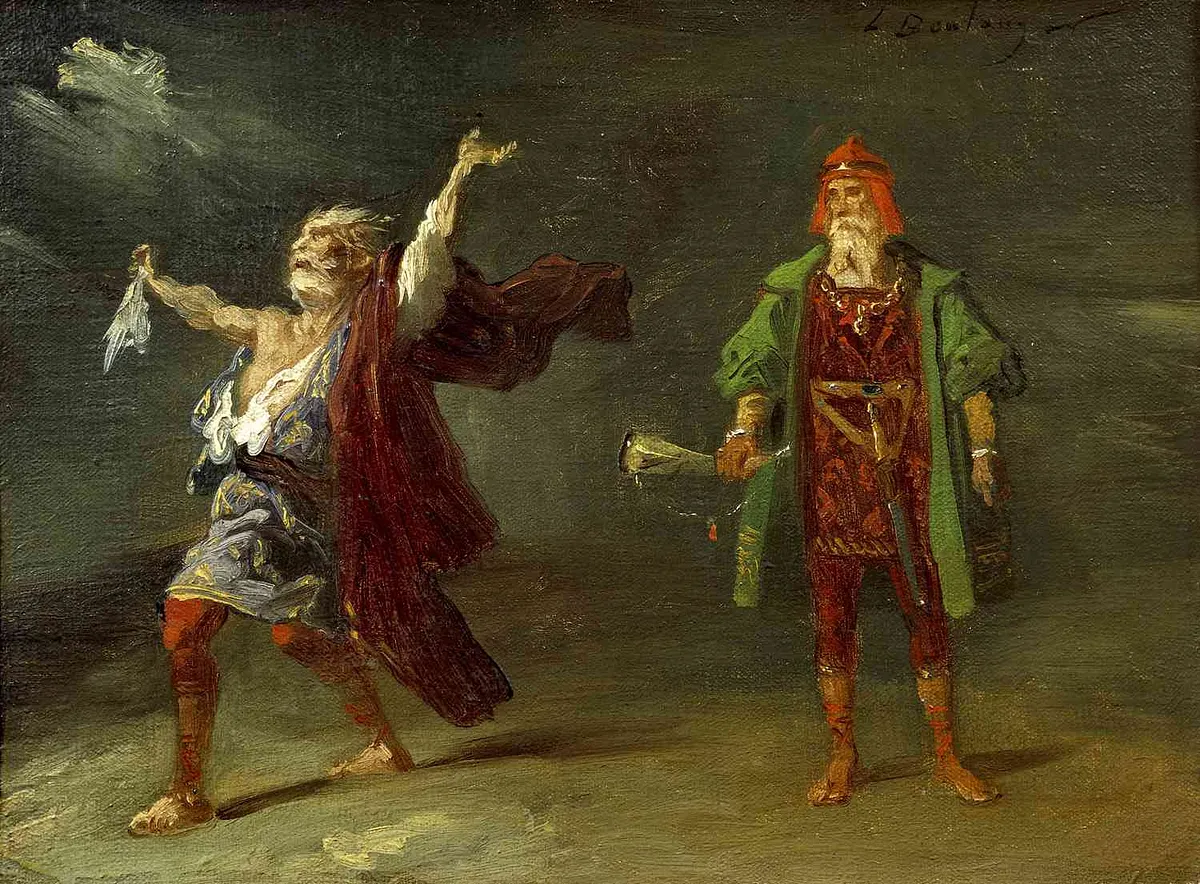
King Lear rages against the storm in Act 3—a king stripped of power, railing at a world that no longer listens. Image credit: Léon Bonnat, “King Lear” (c. 1860). Oil on canvas.
This is when Lear begins to split open. The storm isn’t just outside—it’s inside him now, and it shakes more than his reason. Something deeper starts to give.
It’s also when he starts to see. Without his crown, without his guards, without the ritual of being addressed as king, he’s just a man. An old man. A father. Someone who got it wrong. “I am a man / More sinned against than sinning.” (Shakespeare, 3.2.62-63)
Lear starts to realize that for all the time he spent wielding power, he never really understood suffering—never really looked at the people who lived outside the palace gates. He begins to speak not like a king, but like someone who has been undone.
“Poor naked wretches, wheresoe’er you are, /
That bide the pelting of this pitiless storm…
O, I have ta’en / Too little care of this.” (Shakespeare, 3.2.32-38)
That line always sticks with me. Too little care. Lear hears the storm, sees the wreckage, and finally starts to understand the damage he’s helped cause. He’s not just pointing at injustice—he’s standing inside it.
I read that and think: what am I still missing? Where have I taken care too late, or not at all? It’s tempting to believe clarity shows up on its own, eventually—given time, distance, age. But Lear didn’t stumble into it. He spent years avoiding it. He chose a version of the world that felt safe, even if it meant leaving the truth outside the gate.
I do that too. Most of us do.
It’s a clarity that only arrives once everything he built around himself has been stripped away. And by then, it’s too late to do much with it.
And Lear isn’t the only one unraveling. As he wanders the storm, Gloucester sets out to help him—not just out of loyalty, but because he’s horrified by the cruelty around him.
Helping Lear escape is a defiant act, one that costs him dearly. He’s captured by Regan and her husband, Cornwall, and what follows is one of the most violent scenes in Shakespeare: Gloucester is tied down, mocked, and blinded onstage.
After his blinding, Gloucester is left physically helpless—cast out and forced to rely on others to move through the world, guided by a stranger. And in that moment, he begins to see the truth about his mistakes, his misjudgments, his failure to recognize real loyalty—he breaks.
“I stumbled when I saw.” (Shakespeare, 4.1.20)
The line sounds simple, but it cuts deep. In King Lear, sight isn’t just about eyes—it’s about reckoning. About finally facing what you couldn’t, or wouldn’t, when the world was still playing along.
Gloucester loses his vision all at once. Lear’s clarity arrives more gradually—through grief, humiliation, and the unraveling of everything that once made him feel secure. As the scaffolding of power falls away, both men are forced to confront what they missed. And only then—bruised, humbled, cast out—do they begin to see.
Lear doesn’t miss the truth entirely—he just sees it too late. By the time he’s reunited with Cordelia, the trappings of power are gone. No guards. No throne. No need to test love through grand declarations.
What’s left is something smaller and more honest. An old man, humbled and grieving, looking into the face of the daughter he once cast aside. He sees her clearly now—the quiet steadiness, the love that didn’t need a performance. And she forgives him. Of course she does. But forgiveness doesn’t save her. And the clarity doesn’t save him.
Soon thereafter, Cordelia is hanged in a prison cell—an order given by Edmund, and one Lear is too late to prevent. When he reenters, he’s carrying her lifeless body, still searching her face for signs of life he already knows aren’t there.
“Why should a dog, a horse, a rat, have life, / and thou no breath at all?... Look on her, look, her lips, / Look there, look there! He dies.” (Shakespeare, 5.3.370–375)
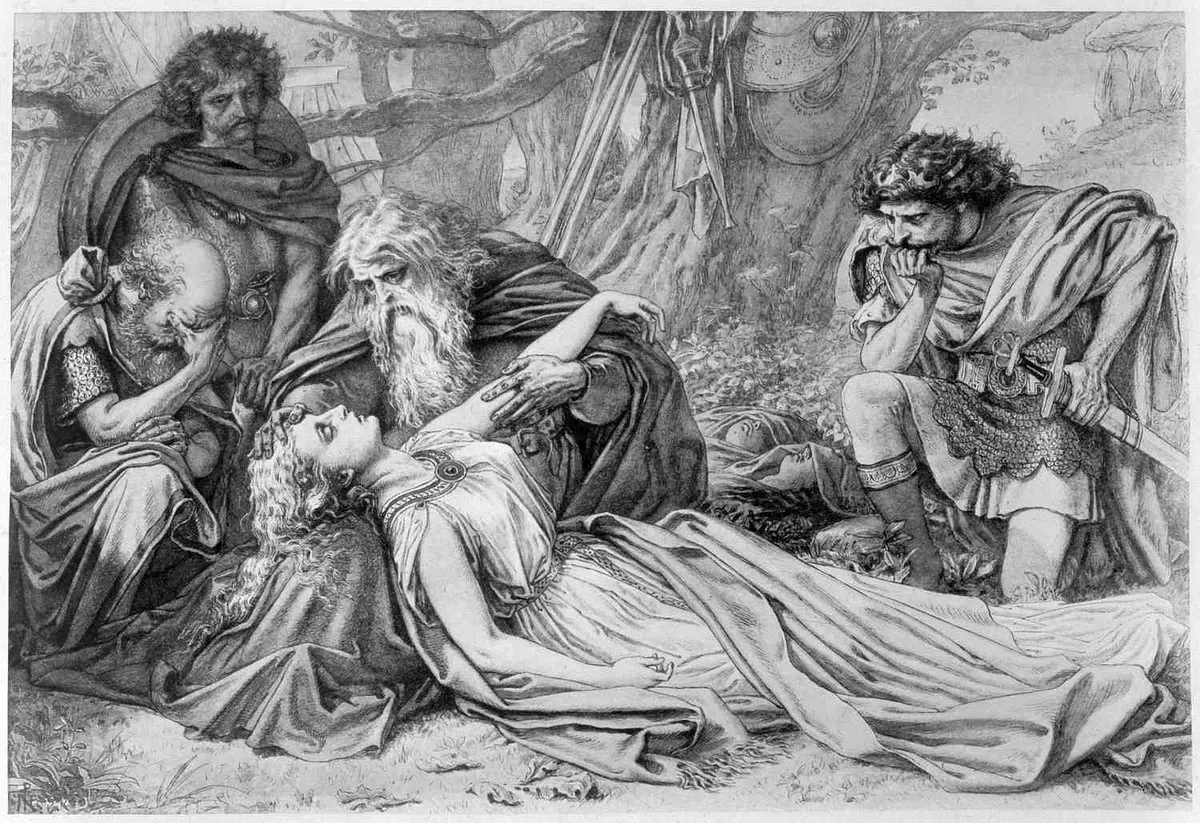
The final scene: Lear holds Cordelia’s body and begs the gods—and the audience—for one more breath. None comes. Image credit: Frederick Sandys, “King Lear and Cordelia” (c. 1866). Engraving.
The line is desperate and unhinged. Lear has lost everything, but it’s not until this moment that grief fully eclipses him. He’s pleading with the gods, with the audience, with himself—willing her to breathe through sheer force of love. But she doesn’t.
This is where the play ends: not in resolution, but in devastation. No reversal. No redemption. Just the brutal silence after too much clarity arrives too late.
Across the kingdom, Gloucester’s ending is quieter—but no less brutal. After he’s blinded, he’s cared for by a stranger, who turns out to be his son Edgar—the son he once cast out. Disguised, Edgar leads him through the wreckage of his life, and Gloucester, unaware of who’s guiding him, follows.
There’s something unbearably tender about that. He’s walking blind through the wreckage of his life, unknowingly guided by the very son he once cast out.
When Edgar finally reveals himself, Gloucester’s heart gives out. He dies in that moment—not from his injuries, but from the weight of recognition. Love had been beside him all along. He simply couldn’t see it.
It’s the most devastating ending in Shakespeare. Because the world doesn’t get repaired. The bad aren’t all punished. The good don’t get rewarded. There’s no Disney Channel ending where the lesson leads to peace and reconciliation. Lear’s hard-earned wisdom comes with no redemption arc—just a body count. A kingdom in ruin. A man crumpled on the ground, realizing that love can’t be commanded, only noticed, and that he missed it while he still had the chance.
And it feels oddly familiar. In a culture obsessed with legacy and optics, we see versions of Lear all the time. Aging CEOs who won’t let go. Institutions that cling to relevance through hollow statements and polished branding. Families who confuse control with care. We reward performance more than presence—until the performance cracks, and by then, no one’s left who actually wants to be in the room.
There’s a version of this story where Lear is just a fool—an aging patriarch who got what was coming. But that reading feels too easy. Because the deeper you get into the play, the harder it is not to see yourself in him. His pride. His blindness. His longing to be loved without having to ask for it the right way. His disbelief that the world might move on without him. The pain of realizing that control was never the same thing as connection.
I think about how many people build their identity around being needed. Around being the one who knows, decides, leads. We see it in politics, in families, in universities, in tech. People who refuse to step aside. Institutions that mistake reputation for moral authority. Entire systems that double down on control the moment they feel it slipping.
But what happens when that version of the self—whether it’s the brand, the role, or the legacy—stops working? When the performance no longer holds, and the audience stops applauding? What remains when being needed is no longer enough?
We don’t wear crowns. But most of us have built our own thrones—carefully curated Instagram dumps, tightly managed expectations, the quiet need to always be right. We dodge vulnerability with polish. We avoid uncertainty by pretending we’ve already arrived. And sometimes, we push people away not because they’ve failed us, but because they’ve told us something true we weren’t ready to hear.
What King Lear reveals—brutally, slowly, storm by storm—is that sometimes collapse is the only path to clarity. That the truth about ourselves is often buried beneath the very things we use to prove we’ve got it together. That kind of love—the kind Lear comes to understand—doesn’t perform. It endures. It stays even when staying makes no sense.
We don’t have to wait until the storm to see. But we might have to let go of the fantasy of being untouchable.
Maybe that’s the hardest part: admitting we’re not in control, and never really were. That what matters most—love, clarity, presence—can’t be demanded, only noticed.
Lear doesn’t walk away redeemed. He dies holding his daughter in his arms, weeping. The throne is gone. The power is gone. What remains is a single moment of understanding—a man looking into the face of what he lost, and finally seeing it clearly. Don’t wait that long.
Thoughts? Reply by email.