How we Understand Decay
There are empty storefronts scattered across New York City. I walk past them on the way to work or while running errands—spaces quietly left behind, windows papered over, a lease…
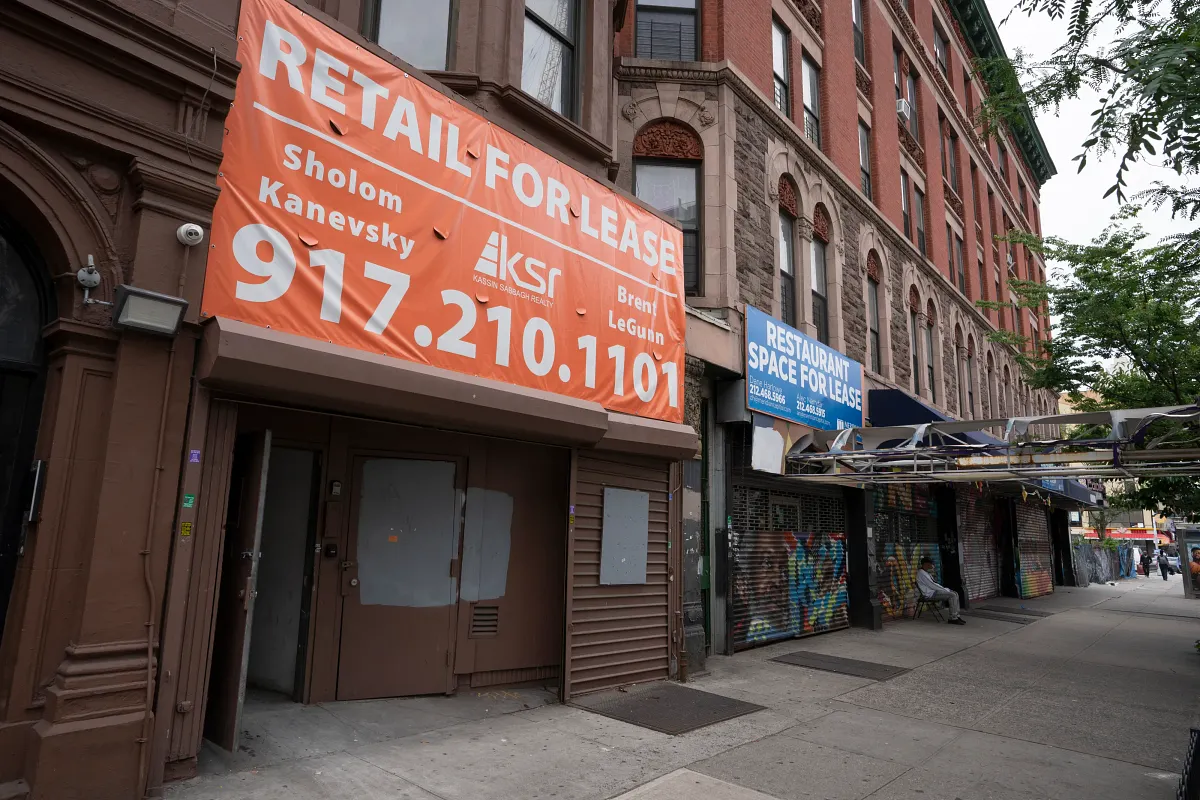
There are empty storefronts scattered across New York City. I walk past them on the way to work or while running errands—spaces quietly left behind, windows papered over, a lease sign taped to the glass. They don’t announce themselves as ruins, and maybe they aren’t, exactly. But they linger in the corners of the city, small interruptions in its constant motion. One used to be a florist—leaves still pressed to the glass, a water-logged calendar curled in the window. Another was a barbershop, the pole gone but the stripe still ghosted on the bricks.
Walter Benjamin, writing in exile in 1940 as fascism swept across Europe, offered a way of thinking about these interruptions. In his Theses on the Philosophy of History, he imagines an “Angel of History”—blown forward into the future while facing the past, watching as the wreckage of history piles up at his feet. The angel wants to stop, to repair what’s been broken, but the storm of progress won’t let him.
Benjamin saw history not as a line of achievements but as an accumulation of debris. And he insisted that what we call “progress” often comes at the expense of what gets discarded. That image—an angel caught in the storm, staring at the wreckage of failed ambitions—comes to mind when I pass these shuttered storefronts. Not because they are dramatic or tragic, but because they mark small ruptures in the illusion that everything is always moving forward.
The city teaches us to overlook these spaces, to wait for the renovation or the rebrand. But ruins—even quiet, accidental ones—can hold a kind of clarity. They remind us that something was lost, even if we’re not sure what it was. And that the future didn’t arrive cleanly. It arrived like this—partially, unevenly, leaving things behind.
What Counts as a Ruin?
We tend to imagine ruins as monumental and distant—ancient temples swallowed by jungle, medieval towers leaning into the hillside, collapsed amphitheaters visited more for their symbolism than their structure. These relics, in the traditional sense, are picturesque. They belong to other centuries, other continents. We encounter them through tourism, textbook photography, or the slow drone shots of a documentary voiceover.
But Benjamin challenges that comfort. For him, history isn’t a clean succession of victories. It’s a continuous accumulation of remnants—layer upon layer of discarded moments, barely concealed beneath the language of progress. Decay, from this angle, isn’t a relic of the past. It’s the texture of the present. And to recognize it isn’t nostalgia—it’s refusal.
That means a ruin doesn’t have to be grand. It can be local. It can be a failed business, a crumbling staircase, a half-finished construction site whose permits expired three years ago. It can be the sun-bleached mural on the side of a bodega, a restaurant menu still taped to the window months after the tables were cleared out. Or it’s the broken ATM machine inside a locked deli, blinking endlessly behind tinted glass. The dusty display of shoes inside a store that hasn’t opened in two years, sizes still mismatched on the rack.
They’re not dramatic or photogenic. But they speak—quietly, insistently—of something tried, abandoned, erased, or simply forgotten.
In a city like New York, where transformation is constant and forgetting is policy, we’re taught not to see these things. Change is the default. Demolition is marketing. Scaffolding, “For Lease” signs, plywood boards—they register less as losses and more as ambient noise. Placeholders. Visual static until something new arrives.
Walk down Canal, Fulton, or parts of the Lower East Side and you’ll see them—rows of shuttered fronts that flicker in and out of use. A place that sold $19 smoothies last summer now boarded shut. Another space stripped to concrete and lit pink for an NFT launch party.
They rarely stay long. One week it’s a shuttered laundromat, the next it’s a wellness studio or a fast-casual chain. The absence is brief, barely acknowledged, paved over by the language of growth. These spaces don’t just disappear—they’re overwritten. And that speed, that erasure, is part of the machinery. The city never lingers.
But Benjamin’s angel refuses that erasure. He doesn’t move on. He stares. That, too, is a kind of politics—a refusal to accept that all forward motion is good motion. A willingness to ask what was sacrificed to build what comes next.
In this way, looking at a ruin becomes a method. It asks something simple, even obvious: what used to be here? But in a world that insists on speed and erasure, even that question can be subversive.
What Gets Left Behind
Cities don’t like loose ends. Especially not this one. Ruins—when they show up—are typically short-lived. A closed business becomes a pop-up. A failed luxury condo turns into “creative office space.” Even collapse gets repackaged. Even absence gets monetized.
There’s a particular kind of amnesia baked into urban progress, where what doesn’t fit the story is either flattened or flipped. You can see it in the language—revitalization, development, renewal. No one ever calls it what it is: covering over something that didn’t work, or that worked only for a few.
This is part of what makes ruins politically unsettling. They resist the rebrand. They remind us that not everything was inevitable, that something else was once here. A shuttered storefront doesn’t explain itself. It doesn’t deliver a moral or a lesson. It just sits there, unfinished, unresolved. A fragment. And fragments are hard to assimilate.
Benjamin understood this. His work wasn’t just about honoring the past—it was about destabilizing the stories the present tells to justify itself. To look at a ruin and not look away is to interrupt that flow. To say: something cracked here. Something didn’t survive the storm. Maybe it was the corner deli that closed after the rent doubled, or the dance studio that held on through the pandemic only to vanish in a wave of luxury redevelopment.
Seeing as Political
Looking is never neutral. Not in a city where attention is constantly redirected—toward what’s new, what’s polished, what’s profitable. To notice a ruin is to break from that script. It’s to linger on what we’re usually told to pass by.
He took this seriously. In The Arcades Project, he treated the shopping arcade not just as a historical curiosity but as a lens—an architecture that revealed the desires, delusions, and contradictions of its time. He didn’t look for monuments; he looked for patterns. For overlooked details. For the ideological work done by glass ceilings, mirror walls, exhibition spaces.
We can do the same now. A failed WeWork gestures toward more than a real estate misstep—it cracks the illusion of flexibility. A vanished fast-fashion chain doesn’t just mark churn; it exposes the fantasy of endless demand. These aren’t one-offs. They’re indicators. Ruptures. Warnings.
Ruins show us where the narrative broke. They mark the points where belief didn’t hold. And seeing them clearly—without flinching, without romanticizing—is a way of refusing the illusion that the present is stable or inevitable. The present isn’t solid. It only feels that way because we’ve forgotten what’s missing.
Benjamin didn’t just collect fragments. He treated them as texts—interruptions that expose the fault lines in our stories. It was about reading them. Letting them disrupt the story we think we’re in. That’s what ruins do if you let them. They interrupt. They speak when no one wants them to. And in that, they become political.
The Ruin as a Counter-Narrative
There’s a strange comfort in ruins—not in the aestheticized, Instagrammable way, but in their refusal to disappear. Ruins don’t explain themselves. They don’t perform well. They don’t scale. They just sit there, quietly insisting that something was lost.
In a culture obsessed with newness, that stillness is disruptive. The ruin doesn’t offer redemption or resolution. It doesn’t pretend to be part of a longer arc toward improvement. It just lingers—unbranded, unresolved.
Benjamin never tells us what to do with this recognition. He doesn’t offer steps or solutions. But his work urges us to pay attention—to hold onto what the present tries to forget. Every fragment, he reminds us, carries not only what was built, but what was broken to make it. “Every document of civilization,” he writes in Theses on the Philosophy of History, “is also a document of barbarism.” The ruin is both.
Most of the spaces I pass—dim windows, locked doors—will eventually become something else. Newer, sleeker, more palatable. That’s how cities work. But maybe that’s exactly why they matter now. Before the plywood comes down, before the next layer of narrative is laid over, there’s a moment when the truth is still visible. When the scaffolding shows.
To look at ruins is not to dwell in the past. It’s to notice that the past hasn’t gone anywhere. It’s still here, under the surface, sedimented into the present. The stories we don’t tell—about collapse, about failure, about what didn’t survive—are often the most revealing.
Benjamin’s angel can’t stop the storm. But maybe we can pause, for a moment, and look.
Thoughts? Reply by email.