Practiced Stranger: Midtown Fluency
How the city trains its people to move, blend, and vanish on cue
Introduction
Steam lifts from a grate, bus brakes sigh, cabs toe the crosswalk. A woman blinks twice into the glare of a Chrysler—months apart, yet she has the same chin tilt, same half-wince. Another set of photos lands at nearly the same minute on different days: same stance, jaw set a touch tighter. An man lifts an iced coffee the same way, napkin looped around the cup. A small half-step slip lets two bodies share one square without touching.
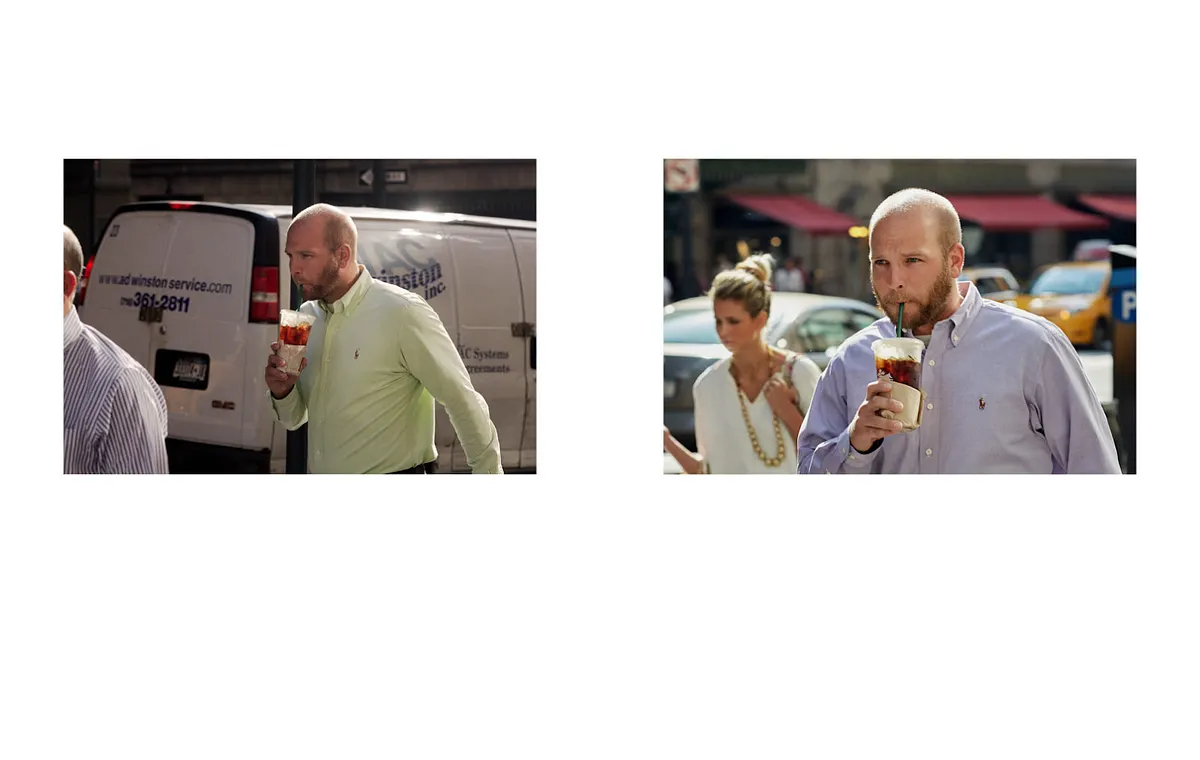
The one person standing still is Peter Funch. For nine years, the Danish photographer returned to the corner of 42nd and Vanderbilt in New York at the same hour, long lens up.
His pictures make a plain point: the city trains our bodies to disappear. Hold the frame steady and the choreography shows itself—eyes fixed on the far curb, bags pulled tight, shoulders lifted against the canyon wind. Everyone keeps moving; almost no one looks back at the man with the camera. Cameras are always running. Recognition is rare.
Method is why this reads true. Funch controls what he can—one corner, roughly 8:30–9:30 a.m., for years—so the background repeats: cabs nosing into the frame, a bus ad sliding by, steam muscling up and thinning in cool air. Against that constant, the variable is his subjects. Hair grays and coats change, but posture converges; the corner teaches a stance and the commuters learn it.
He’s not an anomaly so much as a patient observer. Earlier in his career, he made composite street scenes in Babel Tales; here he drops the tricks and lets time do the work. You might hear echoes of Walker Evans’s subway poise or diCorcia’s chance heads, but Funch’s twist is endurance: stand still long enough and routine writes the picture.
What unsettles is the one-way attention. Hundreds pass within feet of a camera and almost none of them register it. Just as we barely clock the small changes in the people we pass each morning, they don’t seem to clock him. Someone has probably photographed you on your walk to work this summer—and you’d have no idea.
That’s the machinery his series exposes: Funch stands still; the city flows; the body learns. Once you see it in these pictures, you start seeing it on your block. And tomorrow morning, the loop will run again.
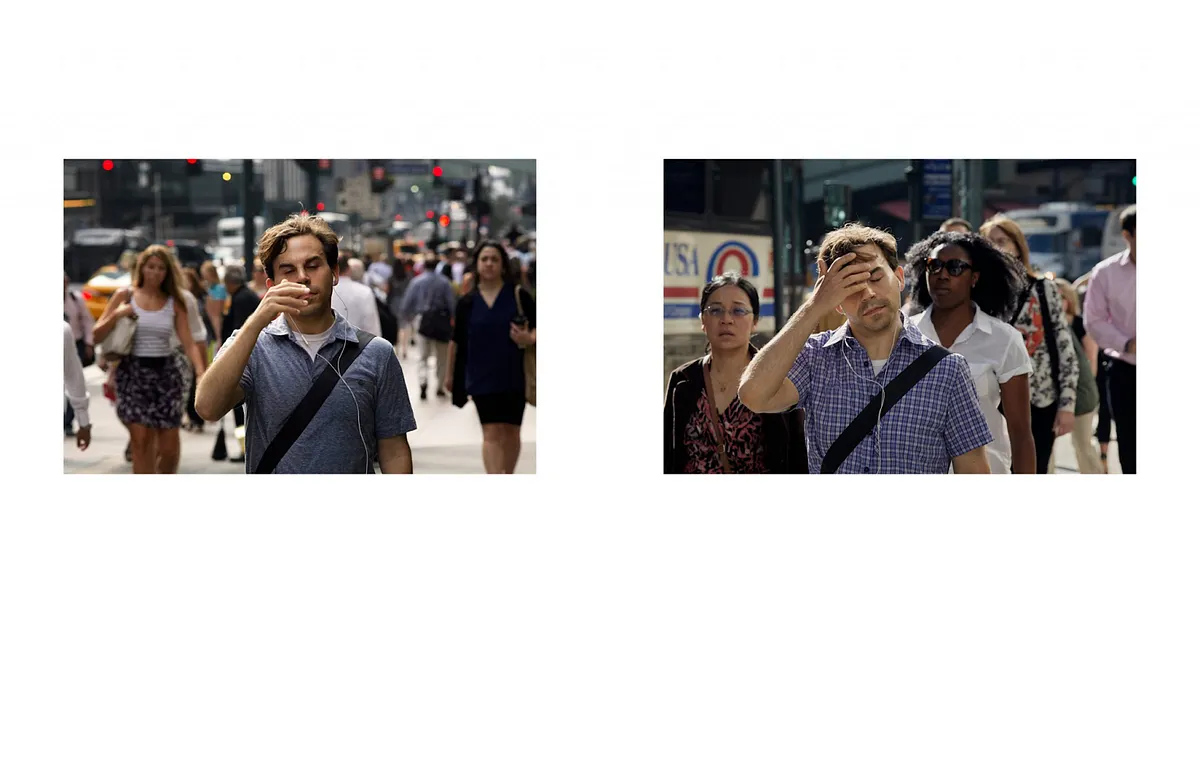
What the corner teaches
Stand on that curb for ten minutes, and the body language starts repeating itself. The half-step slip happens every cycle: two people commit to the same square, each tilts a shoulder, and they pass through each other’s air without touching. You can almost hear the beat it lands on—the soft scuff of rubber on concrete, the hiss of steam from the vent.
Watch the bag grip. Briefcases ride high and tight against the ribcage; totes get pinned at the hip right before the sidewalk narrows by the scaffolding. The move saves a collision and a spill. In winter, gloves catch on canvas; in July, fingers leave a dark half-moon of sweat where they rest.
Then the numbered walk. Eyes flick to the pedestrian signal at 03—a cluster leans forward together, like the curb itself shifted an inch closer to the street. Half the diptychs might as well share a timestamp; the posture is that consistent.
There’s a wind posture, too. This canyon always presses from one side, so shoulders rise just enough, and chins lean a little off-axis, angled away from the gust. Coats change, hairlines retreat, but the stance converges. In one pair, you can pretend it’s a coincidence. In twenty, it reads as coached.
Even the ground teaches. After rain, a single shallow flagstone pools near the mailbox. No one looks down, yet almost everyone arcs a foot around that square. You can tell who’s new by the splash.
None of this is arranged. Funch fixes the frame at the same place, same hour, and the little codes surface on their own. A corner is a teacher with no syllabus. You learn the steps because the crowd knows them, because the block rewards fluency and punishes hesitation, because moving like everyone else gets you through.
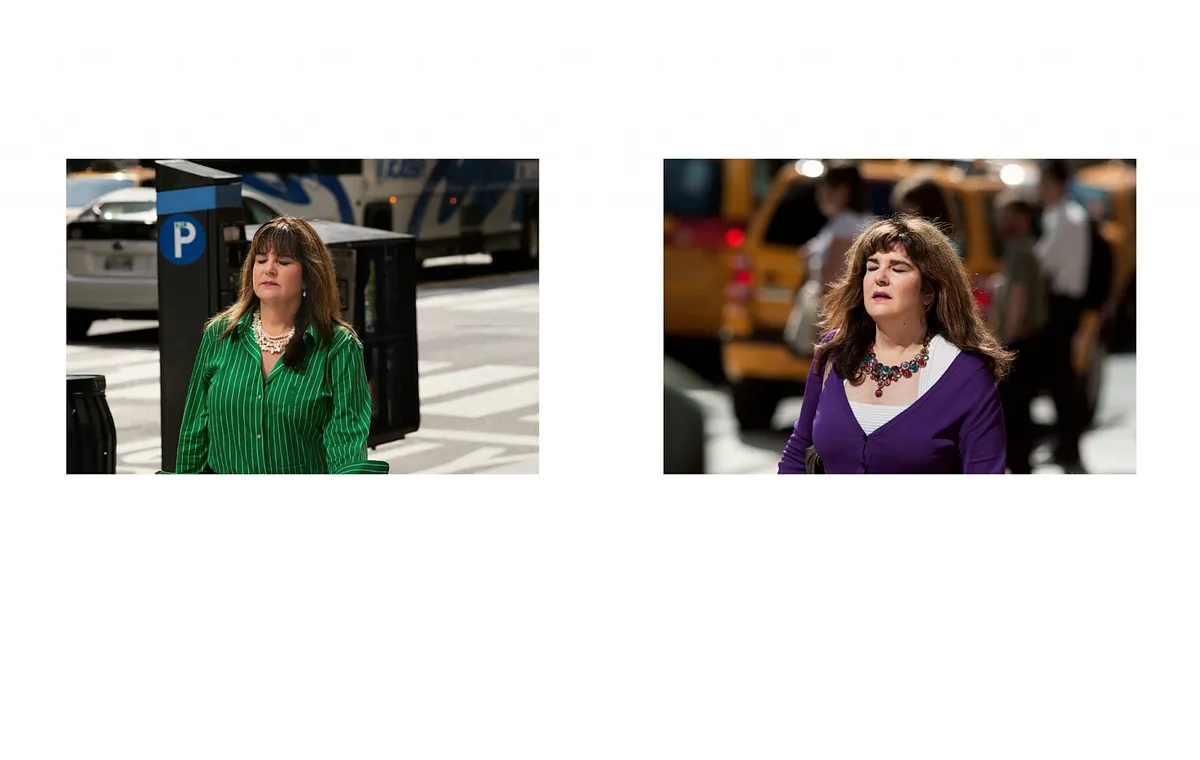
Recorded Isn’t Seen
Look at the photos one by one, and something strange starts to happen. Faces double, gestures echo. It’s not just déjà vu—it’s choreography. Like the city is looping itself, or we’re the ones repeating.
But stack the images into a grid—frame after frame after frame—and something shifts. The faces stop reading as people and start reading as patterns. Your eye stops saying her and starts saying that gesture. The cast becomes a rhythm: scarf-tuckers, jaw-setters, the ones who squint before they cross. That’s the uncanny part: Funch’s camera remembers every pore, every flyaway hair, every fingerprint of a morning. But the more you look, the less you see.
Which is how it works on the street, too. We pass hundreds of people each day and register almost none of them. A thousand glances slide past before one lands. And on the other side of the lens, it’s the same: almost no one looks back at Funch. He’s pointing a camera at people from across the street in broad daylight—and yet in hundreds of photos, almost no one notices him.
It feels accurate. Someone probably photographed you on the walk to work last week. You didn’t see them. They didn’t really see you.
The Payoff and the Price
There’s a reason people move like this. These gestures—the shoulder tuck, the bag grip, the half-step pivot—aren’t about mimicry or style. They’re adaptations. If you live in New York long enough, the city teaches you how to move through it without creating friction. How to take up less space, cross at the right second, and adjust your body to the current rather than interrupt it.
The reward is simple: you get where you’re going. You arrive dry, intact, unseen. In a place that moves this fast, blending in is a form of intelligence. It’s what lets you slip through unnoticed, unbothered, even a little invincible.
But the cost is harder to name. You don’t lose your face, exactly—you lose what it might have asked from someone else. You become legible to the city in the most efficient way possible: as one more figure in the flow. One more commuter with the same bag strap, the same gait, the same half-scowl at the same red light.
And the thing is, it works. That’s what makes it eerie. Funch doesn’t photograph failure—he photographs fluency. He shows how the city trims its people into shape. Not by force, but by rhythm. You learn to move like everyone else because the infrastructure rewards it. Because the sidewalk is narrow. Because the countdown always starts from ten. Because hesitating in the wrong spot gets you nudged, bumped, swallowed.
There’s no villain here—just a system that runs smoother when you give yourself to it. You stop standing out, and things get easier. But after enough seasons of this, it’s hard to tell what you gave up. Something in the walk. Something in the face. Something you used to do with your hands before you needed them to carry coffee, keys, and a phone at once.
Funch doesn’t editorialize. He just holds the frame. And in that stillness, you can see the slow subtraction of difference—how a city sandpapers individuality into pattern. How well it works. How quietly.
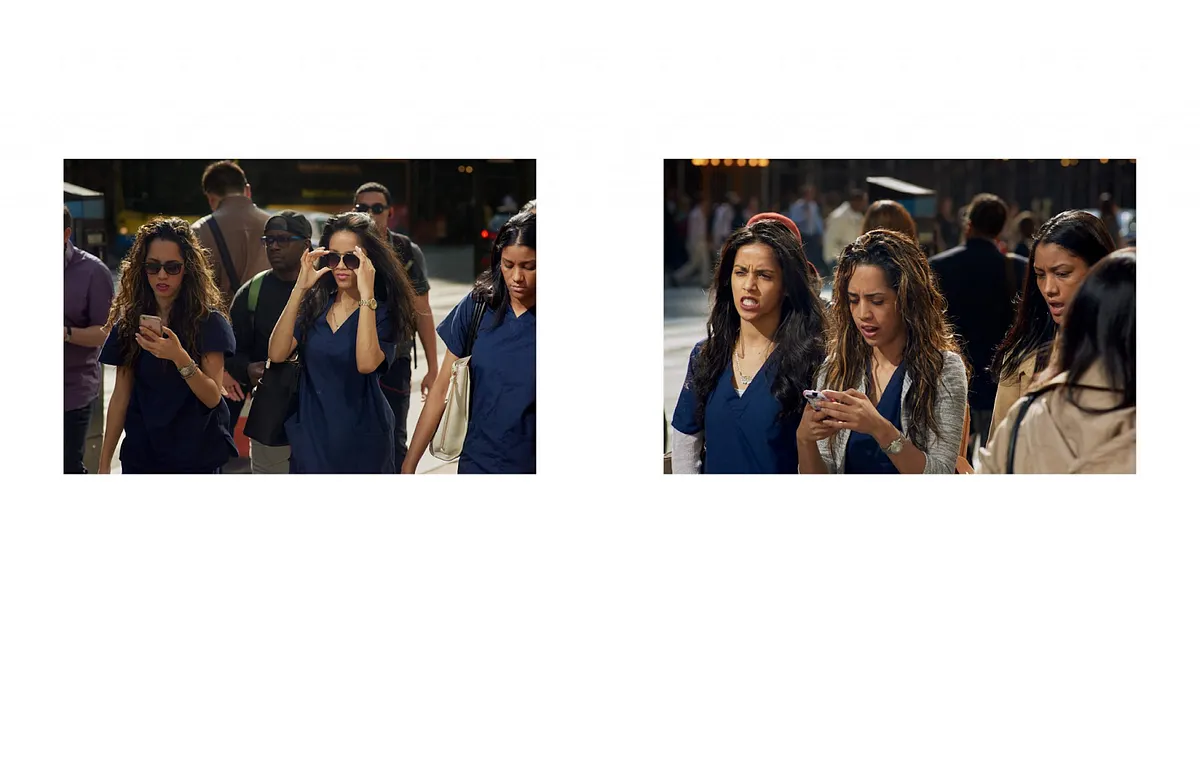
The Still Point
What gives the work its quiet charge is that Funch himself doesn’t move. He picks a single frame and stays inside it. For nine years, five days a week, at roughly the same hour, he returns to that spot just off Grand Central and watches the city play itself out. He never chases. He never intervenes. He just stands there, waiting for someone to appear the same way they did months or years before.
That discipline—his refusal to join the flow—is what makes the patterns legible. He becomes the still point the city organizes itself around. Not because it cares that he’s there, but because he’s the only one watching long enough to see it happen.
In his photographs, repetition is the condition, not the exception. People don’t stand out because they resist the system—they stand out because they follow it so precisely. Their gestures are practiced. Their posture is correct. They’ve been trained by the corner. And they’re captured not at their most expressive, but at their most fluent.
Which leaves us with an open question: if someone watched you that closely, what would they see? Not on your best day. Not on your worst. Just on a Tuesday. On your way to work. Holding the coffee cup the same way you always do. Wearing the coat that now just feels like part of your back. Stepping off the curb half a second early, again.
We like to think of visibility as a kind of agency. To be seen, we assume, is to be known. But Funch’s images complicate that. They suggest that being visible isn’t the same as being noticed. That being recorded isn’t the same as being recognized. That you can appear in full color, in forensic detail, and still vanish into the system.
And maybe that’s the real trick of the city. Not that it erases you—but that it renders you perfectly legible and completely forgettable at the same time.
Thoughts? Reply by email.