In Search of Lost Time?
How still‑image time travel showed me memory can feel like entrapment.
There’s a place I keep returning to—not physically, but in memory. My freshman dorm room. It had a small bed crammed under a wall of movie posters I don’t relate to anymore. A portable A/C unit the school kept emailing me to remove. The carpet was that dorm-issue kind—brown and blue, the color of nothing in particular.
I spent whole days in there, sketching in a notebook I carried everywhere. Doodles, half-formed thoughts, the occasional drawing of the room itself—my desk, the corner of the bed frame, the way the light came in late in the afternoon. I would move the bed around often. It never seemed to fit.
I would draw almost every night. Then I stopped, trading paper and pencil for watercolor and acrylics.
I still have that notebook, and flipping through it now, I’m pulled right back into that space.
Last summer, while I was living in New York—still sketching, still filling notebooks—I picked up Hua Hsu’s memoir Stay True (2022). Somewhere in the middle of the book, after another quiet night spent doodling alone in my apartment, I came across his description of a short film called La Jetée (1962). A story told entirely through still photographs. A man haunted by a memory he never fully understood.
I looked it up. Twenty-seven minutes. A bunch of still images. And a Vimeo link.
I watched it once. Then again. Then again. I couldn’t stop. It was like someone had made a film out of the feeling I’d been trying to explain for years—the way a memory loops to remind you of what can’t return to.
La Jetée isn’t a film in the conventional sense. There’s almost no movement and no dialogue, except for a French voiceover with English subtitles. And no acting, only still photographs. It runs a mere twenty-seven minutes, and yet it feels suspended—like it’s happening inside of a dream you only half-remember.
It tells the story of a man living in the ruins of a postwar Paris—one imagined in a future ravaged by nuclear disaster, where what remains of humanity has been driven underground. Scientists, desperate to salvage what's left of civilization, begin experimenting with time travel. They send this man—the protagonist—into the past, using memory as the only stable bridge.
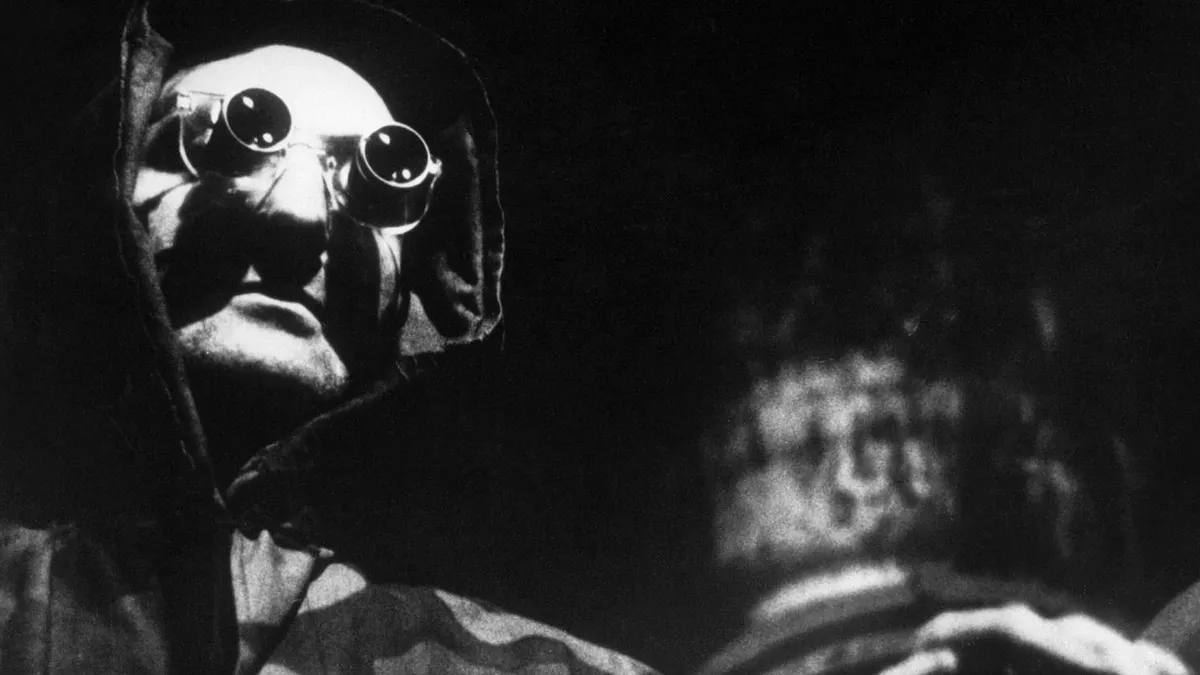
One of the film’s underground experimenters, cloaked in darkness and heavy goggles. He watches the protagonist with clinical detachment—an emblem of the post-apocalyptic future where memory becomes both experiment and sentence.
His mission is technical. Save the world. But what he finds is emotional: a woman. A moment. A feeling he once glimpsed as a child on the observation deck of Orly Airport. It’s this fragment of memory—half image, half impression—that guides everything.
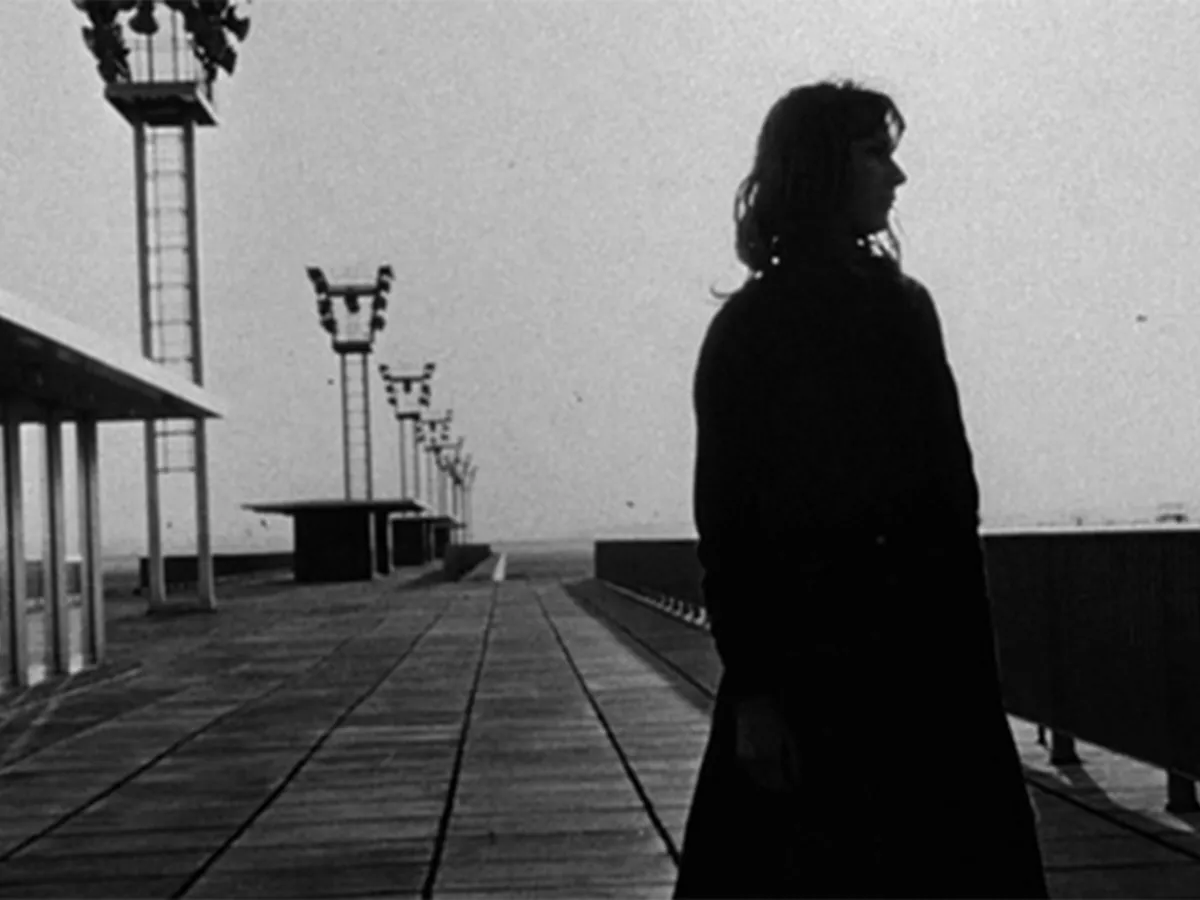
The woman stands on the Orly Airport observation deck, her silhouette framed by industrial light towers and open sky. For the protagonist, this moment—this quiet, almost accidental glance—becomes the anchor of everything that follows.
When I first watched the film, I didn’t think of it as science fiction. I didn’t even really register the apocalyptic setting. What stuck with me was the quiet ache beneath the plot—consuming a man who is unsure of why he remembers what he remembers, and is still ruled by it.
And something about that—about the stillness, the obsession, the way a single image can become a life raft—felt familiar.
My notebook from freshman year has more of me in it than I realized at the time. I used to fill it without thinking—half-drawn figures from films I was momentarily obsessed with, fragments of overheard conversations scribbled down without context, lists of habits I thought I needed to become a better person. There’s a whole page where I tried to draw the same hand over and over and still couldn’t get it right.
There’s no narrative in the notebook—just repetition. The same ideas reworked from different angles: the shape of a room, the longing behind a face, the same stack of books placed differently, the same poster of a band I’ve outgrown as it peeled by the corners. Figures are thrown all about. It’s not a diary. It’s surveillance. And I was both the subject and the observer.
That’s what watching La Jetée felt like: staring at still frames that weren’t trying to explain themselves, but refusing to be forgotten. A story told not through motion, but through accumulation.
One of the central ironies of La Jetée is that the protagonist is chosen for time travel precisely because of his overwhelming attachment to a single memory. That’s the premise: memory isn’t just a shadow of the past, but a place so emotionally charged it can be reentered—like a portal.
He returns to the same moment again and again: a woman’s face, sunlight falling across her features, the edge of a glance at the Orly airport. It’s a memory from his childhood—fleeting, almost dreamlike. Something about it holds him, like it's more than just a memory, like it’s waiting to become something else.
He doesn’t know why that moment matters. Only that it anchors him. It’s what makes the past feel real.
And maybe that’s the real function of memory—not to show us the truth, but to convince us that the past happened at all.
When I flip through that old notebook, I don’t feel clarity. I feel something closer to vertigo. The drawings aren’t vivid or expressive—they’re half-present, distracted, the kind of marks you make when you think nothing important is happening. But that’s what makes them so haunting now.
It’s not what I was capturing. It’s everything that sits just outside the edges: the voice down the hall, the unopened email, the people you shared the space with, the feeling that time was endless and nothing mattered yet.
That’s what I’m chasing—not the drawings themselves, but the atmosphere around them. The shape of time as it bent in on itself.
Upon watching La Jetée for the third, maybe fourth time, I noticed how the film doesn’t loop in any obvious way—yet it still feels circular. Not because it’s repetitive, but because it’s recursive. The man dives deeper into the same memory, each time peeling back a little more. The woman looks slightly different. The lighting changes. There’s no progress, only sharpening.
That’s how I experience memory, too. A fixed image I rotate like a puzzle piece, trying to make it click into a shape that explains something I still don’t understand.
The director, Chris Marker, stages this beautifully: the same stills, the same scenes, reappearing across different moments in the story. And then, just once, the rules break. The woman blinks. Her face moves. It’s the only moving image in the entire film. And it lands like a breath breaking the silence.
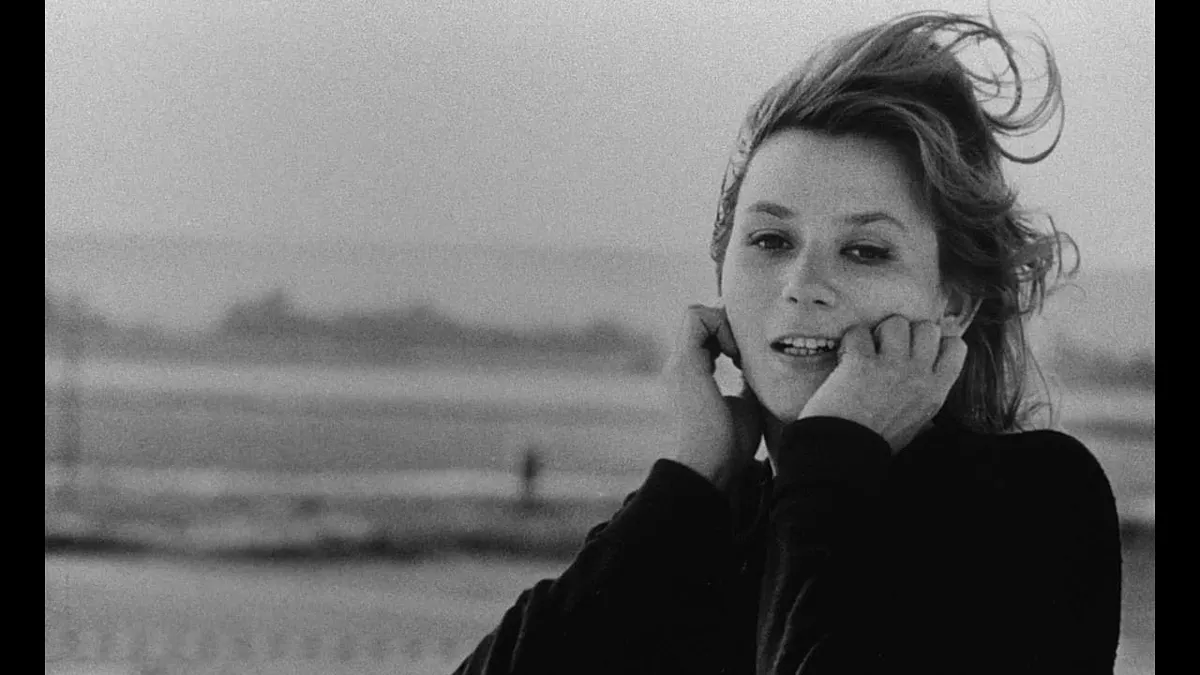
The only moving image in the entire film: her eyes flutter open, she breathes. In a world of still frames, this single motion lands like a miracle—a fleeting glimpse of life reanimating memory.
I remember the moment she blinked—exactly. I sat upright, rewound the clip, watched it again. In a film composed of stillness, any kind of motion has a way of feeling like a revelation.
That moment—the blink—reminded me of how monotony works. The days blur. Time freezes. And then, suddenly, something breaks through—a laugh, a dream, a sound that shouldn’t be there. A small, impossible sign that something’s still alive inside all the quiet.
There’s a moment near the end of La Jetée when everything seems to align. The man has returned to the memory he’s spent the entire film chasing—the glance at Orly, the woman’s face. He’s back at the airport. He sees her. It feels like resolution is finally within reach—that if he can just hold onto this moment, he might be saved.
But instead, he dies.
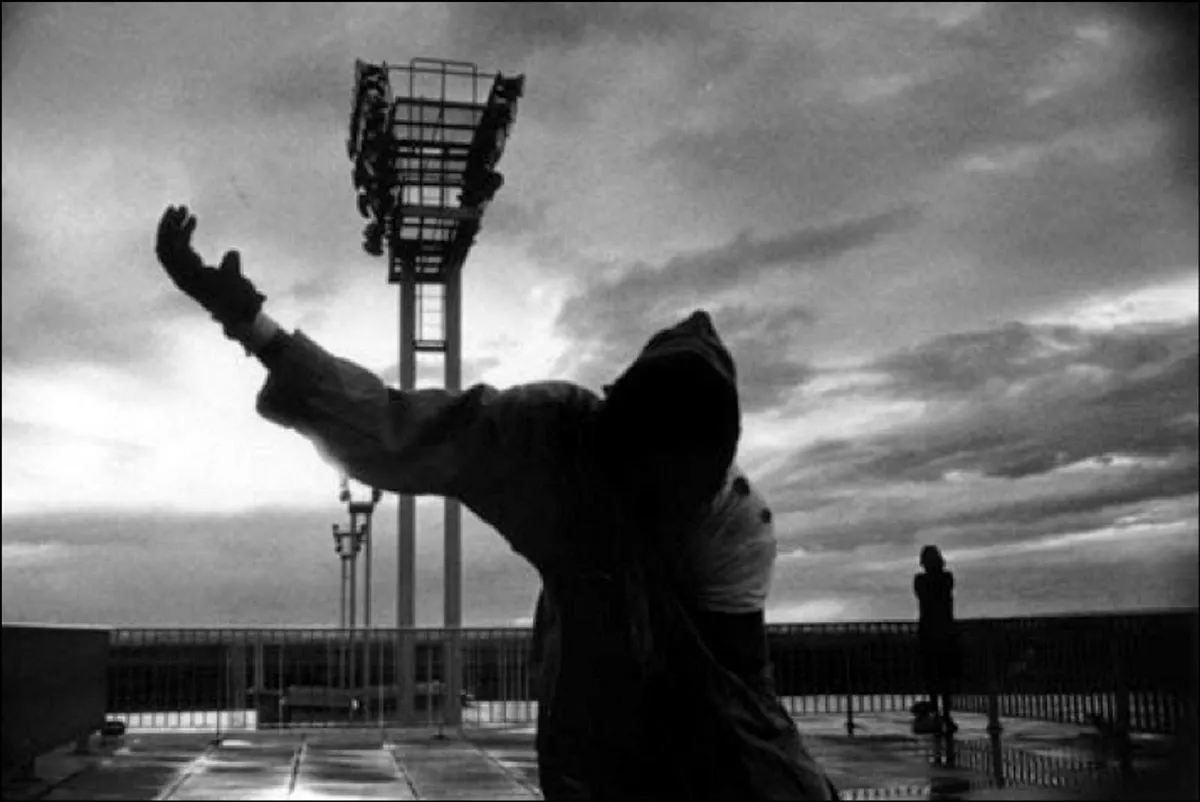
The final return to the airport. As the man runs toward the memory he’s chased across time, the loop closes.
Just before it happens, he realizes that the memory he’s been chasing is the moment of his own death. What appears sudden is truly inevitable. The scene he witnessed as a child—a man collapsing on the airport observation deck—was actually a vision of his own death, seen from the future. The moment he had always remembered as safe turns out to have been the end of his life.
I think about that a lot. The risk of memory. The possibility that the things we return to for comfort might also be the things that undo us. That notebook—it doesn’t bring peace. It never has. If anything, it makes things feel vivid.
There are days I flip through it, trying to feel close to something I’ve lost—certainty, maybe. Or softness. The way I used to move through the world without needing to understand it. But what I usually find is a strange kind of distance. Like I’m watching a version of myself I no longer recognize but still feel responsible for.
It’s not that I expect the pages to offer answers. It’s that part of me wonders if, by looking long enough, I’ll finally understand what I didn’t know I was living through.
But some moments resist interpretation. Some records weren’t meant to explain. Only to exist.
We like to believe that memory is healing—that to remember is to honor, to preserve, to keep alive. But La Jetée suggests something harder: that memory can also be a kind of trap. That looking back might not take us anywhere at all. It might just fold us further into ourselves.
The protagonist believes he’s moving forward, that he’s reclaiming something—love, meaning, time. But what he’s actually doing is completing a loop that was always closed. The end was there from the beginning.
It’s easy to think of time travel as science fiction. But what Marker suggests—gently, devastatingly—is that we all do it. Every time we revisit a memory, we’re traveling through a version of ourselves that no longer exists. That memory is less like a scrapbook and more like a rerun: comforting, familiar, and ultimately unchanged.
That notebook still lives on a shelf in my apartment. I don’t open it often, but I know exactly where it is. Some days I’ll flip through the pages without really knowing why. Not because I expect to find something new—but because it’s one of the only places I can still feel the presence of a time I didn’t know was slipping away while I was living it.
Maybe that’s the real cost of remembering—not that it hurts, but that it never finishes. That some sketches and impressions stay sharp no matter how many years pass. That memory, like La Jetée, resists closure.
It’s not there to be solved. It’s there to sit with you—quietly, unchanging.
Thoughts? Reply by email.